Louvre Abu Dhabi
A universal museum under a dome of woven light, with masterpieces from every era and region.
Official site ↗
Home›Culture›Timeline›United Arab Emirates: History and Culture
United Arab Emirates
United Arab Emirates history reaches back five thousand years to the tombs of Umm an-Nar and the oasis towns of Al Ain, long before the skylines of Dubai and Abu Dhabi. Emirati culture, shaped by desert, sea and a remarkable union in 1971, welcomes visitors with coffee, dates and pride.
At a glance
Eras of United Arab
Some of the oldest evidence of humans leaving Africa has been found at Jebel Faya in Sharjah, inscribed in 2025 as the Faya Palaeolandscape, a World Heritage Site. In the Bronze Age, the Umm an-Nar culture built round stone tombs and traded copper from the Hajar Mountains with Mesopotamia and the Indus Valley. The falaj irrigation channels of Al Ain, part of a World Heritage Site, have watered date groves for some three thousand years.
Ed-Dur in Umm Al Quwain and Mleiha in Sharjah were thriving towns in the centuries before Islam, which arrived in the 7th century. Julfar, near today's Ras Al Khaimah, became a great medieval port. For centuries, coastal communities lived from pearling, fishing and trade, while Bedouin tribes moved between oases. Ruling families such as the Al Nahyan of Abu Dhabi and the Al Maktoum of Dubai led their communities through these generations.
On December 2, 1971, Sheikh Zayed bin Sultan Al Nahyan and Sheikh Rashid bin Saeed Al Maktoum led the founding of the United Arab Emirates, and Ras Al Khaimah joined in early 1972. Oil revenues built a modern nation that now leads in aviation, tourism, space and artificial intelligence. See the royal families of the Middle East, pearling history and the UAE Centennial 2071 vision.
Languages and five useful
Emirati Arabic is a Gulf dialect, and with more than 200 nationalities living in the country, English is the common language of daily life.
| English | Local phrase | Say it like |
|---|---|---|
| Hello | As-salamu alaykum | ah-sah-LAH-moo ah-LAY-koom |
| Welcome | Marhaba / Hayyakum | MAR-ha-ba / HAY-ya-kum |
| Thank you | Shukran | SHOOK-ran |
| How are you? | Shlonik? | SHLOH-nik |
| God willing | Insha'Allah | in-SHAH-al-lah |
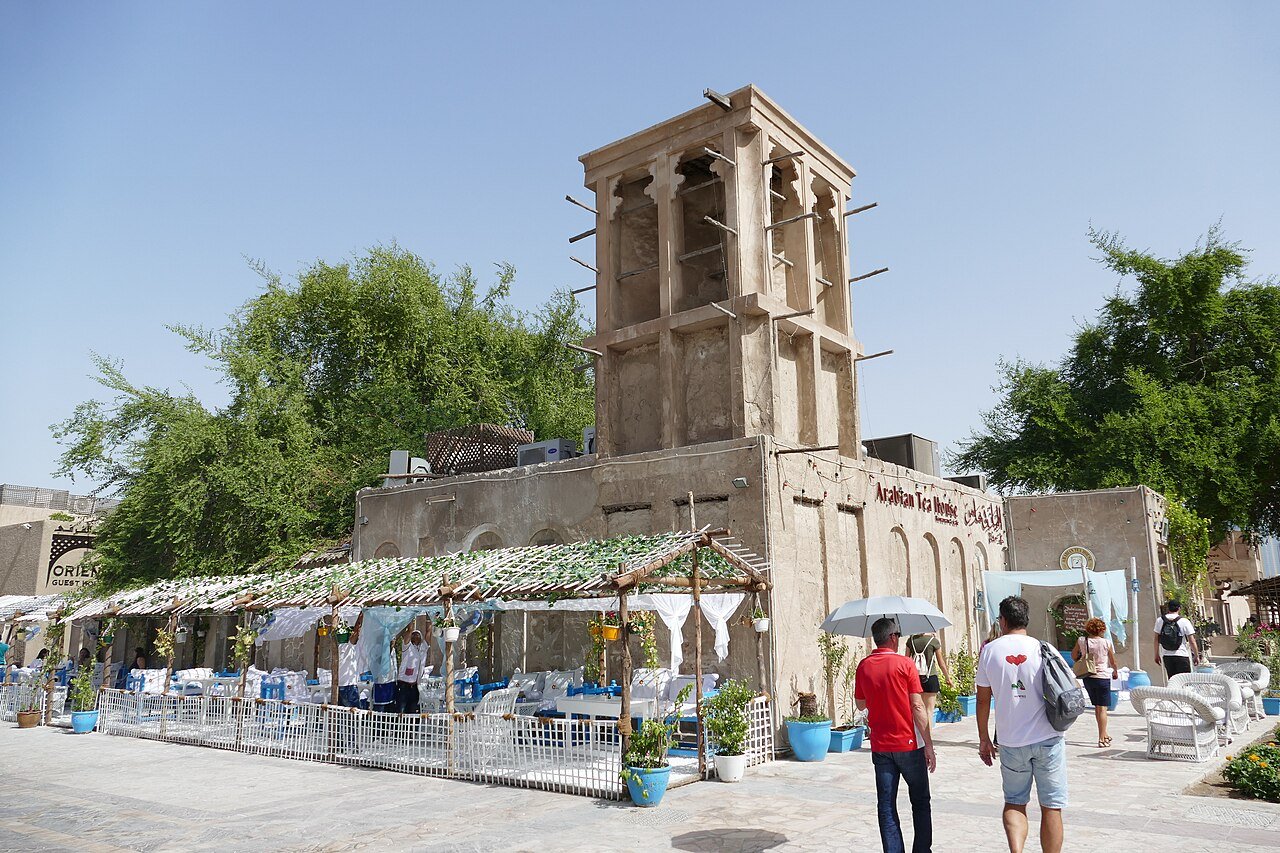
Traditional crafts include Al Sadu weaving, talli embroidery with silver threads, and khoos palm-frond weaving, several recognized by UNESCO. Old Dubai's Al Fahidi district preserves coral-stone houses topped with wind towers, the original air conditioning of the Gulf.
Today the UAE is a global stage for art and architecture: Jean Nouvel's Louvre Abu Dhabi under its floating dome, the Burj Khalifa, the Museum of the Future and Sharjah's Islamic arts heritage. Art Dubai, the Sharjah Biennial and Abu Dhabi Art bring the world's collectors. See the great Middle East museums and art galleries and auction houses.
Emirati food is warm and generous. Machboos, spiced rice with meat or fish, is the classic main dish, and harees and thareed are Ramadan essentials. Breakfast might bring chebab, saffron pancakes with date syrup, or balaleet, sweet vermicelli with an omelet.
Luqaimat, golden dumplings drizzled with date syrup, are sold at every heritage festival. Gahwa, Arabic coffee with cardamom and saffron, is poured by the host from a dallah into small cups and served with dates, a custom recognized by UNESCO. See Arabic coffee and dates.
A universal museum under a dome of woven light, with masterpieces from every era and region.
Official site ↗The national museum honoring Sheikh Zayed and the story of the land and its people, opened in December 2025 in a building by Foster + Partners.
Official site ↗Opened in November 2025, it traces 13.8 billion years of the story of the universe and of life on earth, with a famous Tyrannosaurus rex and the Murchison meteorite among its highlights.
Official site ↗Frank Gehry's museum of modern and contemporary art, the largest Guggenheim, completes the Saadiyat Cultural District. Read more on our Guggenheim and Zayed National Museum page.
Official site ↗The oldest stone building in Abu Dhabi, once the ruling family's fort and home, now a museum.
Official site ↗Wind-tower houses, galleries and cafes, and nearby the museum telling the story of the 1971 union.
Thousands of objects of Islamic science, art and faith on the Sharjah waterfront.
Official site ↗Falconry, a UNESCO-recognized heritage the UAE has championed, camel racing and the Al Ayyala dance, performed with bamboo canes to drums, appear at festivals and National Day celebrations. The majlis remains the place where community gathers. Read about Arab hospitality and the majlis and Bedouin heritage.
The UAE sent a probe to orbit Mars in 2021, a first for the Arab world. The Burj Khalifa is the tallest building on earth. Sheikh Zayed planted millions of trees, greening parts of the desert. Plan your trip with our UAE luxury travel guide, and explore Abu Dhabi, Sharjah's museums and the oasis city of Al Ain. In 2026 Wadi Wurayah in Fujairah, a mountain valley of waterfalls and pools, became the country's first natural World Heritage Site; see our Fujairah east coast guide.
Ultra-Luxury Real Estate · Own Here
The places you discover as a guest are the places to own. Freehold for foreign buyers in designated areas, with a golden visa route from AED 2 million.
Ultra-Luxury Tourism & Ultra-Luxury Real Estate
Checked October 2026. Prices and dates are approximate and can change. See our standard.