Iraq Museum
One of the world's great archaeological museums, with Sumerian, Akkadian, Babylonian and Assyrian treasures, including winged bull guardians.

Home›Culture›Timeline›Iraq: History and Culture
Iraq
Iraq history is the story of Mesopotamia, the land between the Tigris and Euphrates where writing, cities and law first took shape. Iraqi culture, from Baghdad's poetry and maqam music to its legendary hospitality, carries that inheritance into the present day.
At a glance
Eras of Iraq history
In southern Mesopotamia, the Sumerians built the world's first cities, Uruk, Ur and Eridu, around 4000 to 3000 BC. They invented cuneiform writing, the wheel used in transport, the 60-minute hour and the epic of Gilgamesh, the oldest great work of literature. The ziggurat of Ur still rises from the plain.
The Akkadians created one of the first empires, and Babylon, under Hammurabi, issued one of the earliest written law codes. Assyria built palaces at Nimrud, Nineveh and Ashur lined with carved reliefs, and Nebuchadnezzar II made Babylon the most splendid city of its age, with the blue-glazed Ishtar Gate and the legendary Hanging Gardens. Persian, Hellenistic and Parthian eras followed; the desert city of Hatra is a striking survivor.
In 762 the Abbasid caliph al-Mansur founded Baghdad, the Round City, and for centuries it was the intellectual capital of the world, home to the House of Wisdom where scholars translated and advanced mathematics, astronomy and medicine. Samarra's spiral minaret dates from this golden age. Later eras brought Ottoman administration, a monarchy from 1921 and the modern republic. Today Iraq is investing in its Development Road and in restoring its heritage. Read about the Islamic Golden Age and the regional timeline.
Languages and five useful
Iraqi Arabic is spoken across most of the country, Kurdish is official and widely used in the Kurdistan Region, and Assyrian, Turkmen and Armenian communities keep their own languages.
| English | Local phrase | Say it like |
|---|---|---|
| Hello | As-salamu alaykum | ah-sah-LAH-moo ah-LAY-koom |
| Thank you | Shukran | SHOOK-ran |
| How are you? | Shlonak? / Shlonich? | SHLOH-nak / SHLOH-nich |
| Very good | Zein kullish | zayn KUL-lish |
| Thank you (Kurdish) | Supas | soo-PAHS |
The Iraqi maqam, a refined vocal tradition rooted in classical Arabic poetry, is recognized by UNESCO, and the oud has deep roots here; Baghdad has produced many of the Arab world's great players. Iraqi poets such as al-Mutanabbi in the classical age and Badr Shakir al-Sayyab in modern times shaped Arabic literature, and Baghdad's al-Mutanabbi Street, lined with booksellers, comes alive every Friday.
Modern Iraqi artists and architects have achieved international fame; Zaha Hadid, born in Baghdad, became the first woman to win the Pritzker Architecture Prize. Traditional crafts include copperwork in Baghdad's Souq al-Safafeer and fine Kurdish carpets. Explore Arabic calligraphy and language and the region's music traditions.
Iraqi food is rich and comforting. Masgouf, carp split open and slow-grilled by a wood fire along the Tigris, is the national dish. Dolma, vegetables and vine leaves stuffed with rice and meat, is a family favorite; quzi brings lamb over spiced rice; and tashreeb layers bread with a hearty broth.
Breakfast might be geymar, thick clotted cream, with date syrup on warm samoon bread. Iraq was once home to millions of date palms and still grows hundreds of varieties. Kleicha, cookies filled with dates and cardamom, are baked for every celebration, and strong sweet tea is offered at every turn. See Arabic coffee and dates.
One of the world's great archaeological museums, with Sumerian, Akkadian, Babylonian and Assyrian treasures, including winged bull guardians.
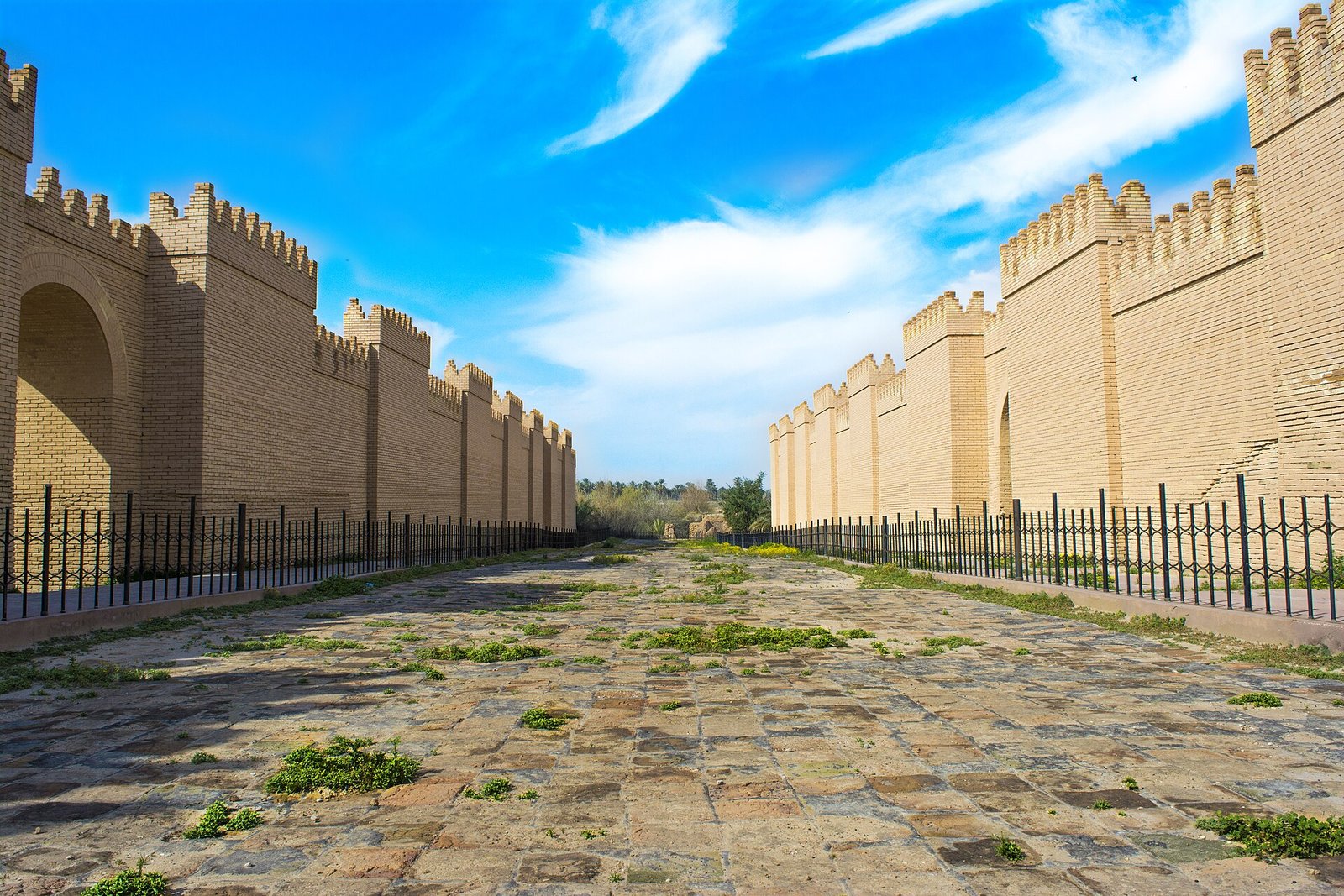
The ancient capital of Hammurabi and Nebuchadnezzar, with processional walls and reconstructed palaces. A World Heritage Site since 2019.
The best-preserved Mesopotamian temple tower, more than four thousand years old.
A mound inhabited for millennia, crowned by a historic town; the Kurdish Textile Museum is inside.
Famous for its spiral minaret, the Malwiya, from the Abbasid era.
Hospitality is sacred, and guests are pressed to stay for one more meal. Nowruz brings spring festivals in the Kurdistan Region, the marshes of the south preserve a unique Ma'dan way of life in reed houses, and the Iraqi Marshes are a natural and cultural World Heritage Site. See also Arab hospitality and the majlis.
The oldest known recipes, written in cuneiform, come from Mesopotamia. The 360-degree circle and the 60-minute hour come from Sumerian mathematics. Many of Scheherazade's tales in the Thousand and One Nights are set in Abbasid Baghdad. Discover more with our Iraq heritage travel guide and our page on Erbil and its citadel.
Ultra-Luxury Real Estate · Own Here
Across the Middle East, the finest resorts and the finest homes now sit side by side, and many international buyers own before they ever visit.
Ultra-Luxury Tourism & Ultra-Luxury Real Estate
Checked October 2026. Prices and dates are approximate and can change. See our standard.